Work In Progress - a Deep Dive
In this article I want to dive deeper into one of the Kanban practices - limiting work in progress. It starts to connect the dots of previous articles.
What are WiP Limits?
The main concept of WiP limits is that you are only allowed to start new work once current work is finished. If you have already discovered and visualized the stages that your work flows through, you can implement limits on how many work items can be in any stage at once. The limits can differ for different stages (or columns). Finding the optimal number of allowed work items is done experimentally. This shift in mindset changes a push system into a pull system, and it changes the perspective away from optimizing for busy people to optimizing for finished work. Keeping people busy is expensive, while finishing work brings money.
Shorter Lead Time, less unfinished work
Let's look into how introducing WiP limits affects the rest of the system and what positive changes it often brings.
First, let's discuss its effects on lead time. I want to illustrate what happens with an example. Imagine your team assembles a complex physical product in an assembly line, but there is one specialist who takes a lot of time in finishing their step. They are a the bottleneck. But in the case where there are no WiP limits, everybody just produces as much as they possibly can, leading to the creation of a huge queue of unfinished products before the specialist's step. How many items are finished depend only on the specialist. Now imagine you are one of these products - you'd be waiting a long time in a queue before it's your turn to be completed! The lead time would be long, the team isn't very responsive to the customers or to a change in environment, possibly the team would even be very hard to predict.
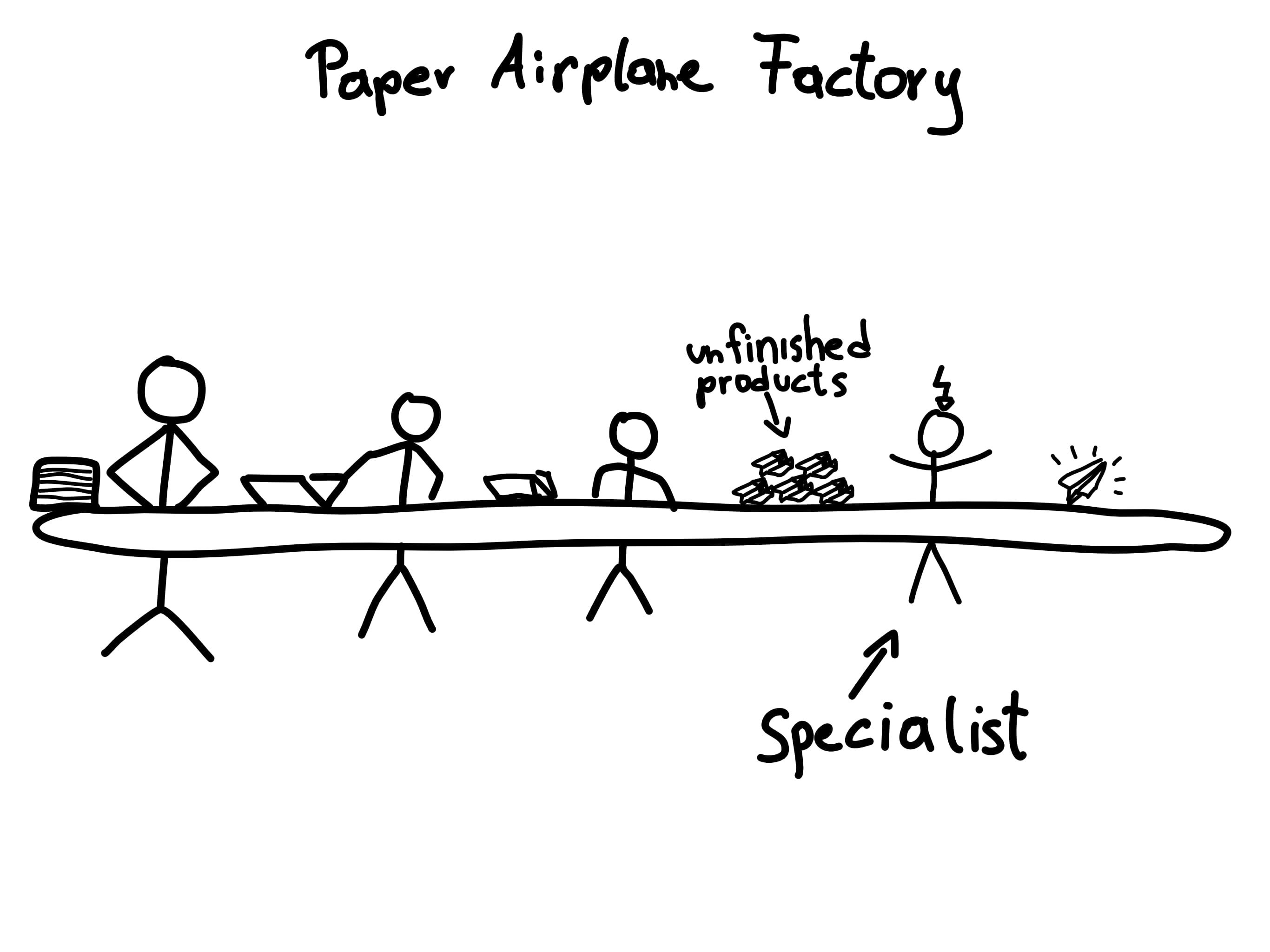
If one were to introduce WiP limits in this team, new products would only be allowed to be worked on once the specialist finishes his step on another one - you'd have a pull system. Now the lead time would reduce significantly, because if you were one of the products being produced, you wouldn't have to wait in a long line before the specialist - you'd be flowing right through the system!
The effect that I just described is known as Little's Law.
Create focus and work more efficiently
More WiP also automatically implies more context switches, and together with that more overhead. Context switches are expensive, because it takes time to get your mind into the right space for a task, and to get going with your work. It's simple, introducing WiP limits, implies less WiP, that means that there are less context switches, which leads to less overhead and finally more efficient work.
Multitasking also creates stress and is a source for mistakes and errors. A common example for this would be texting while driving.
Try it yourself!
In summary - if you go about introducing WiP limits the right way, and then also experiment with changing the limit to see how it affects throughput and lead time, it is very likely to produce positive change in your team and perhaps even your organization!